
Architects of Japan’s Easy-Money Policies Are Changing Their Minds
As the Bank of Japan weighs another rate increase on Friday, a divide over how Japan should confront inflation is widening.

Malaysian business and markets news
Business and economy news from other publishers, in Malaysia, the region and the world.
As the Bank of Japan weighs another rate increase on Friday, a divide over how Japan should confront inflation is widening.
China's value-added industrial output increased by 5.3 percent year on year in the first eight months of 2026. Retail sales of goods and services, a major indicator of the country's consumption strength, increased by 2.5 percent, fixed-asset investment dropped 7.2 percent and the surveyed urban unemployment rate averaged an unchanged 5.2 percent. For the month of August, output grew 5.2 percent from a year earlier, quickening from a 4.5 percent increase in July and beating expectations for a 4.8 percent rise, data released by the National Bureau of Statistics showed on Tuesday. Retail sales rose 0.4 percent, slowing from a 0.6 percent gain in July and below an expected 0.8 percent rise. The figures underline the continuing mismatch between resilient production and exports on one hand, and fragile household consumption and investment on the other, and raised the stakes for more stimulus measures to address the weaknesses in the economy. Extreme weather likely remained a drag on activity. Four typhoons made landfall in China during August, disrupting operations in the east-coast manufacturing and logistics belt. Beijing has responded with faster government bond issuance and expanded loan interest subsidies for small private firms and consumers, while the central bank has pledged additional policy support without signalling explicit cuts to policy rates or banks' reserve-requirement ratio. The bureau says residents' ability and willingness to spend should be enhanced and the supply of high-quality goods and services should be improved. It expects the economy to maintain steady growth even as it faces structural pressures. "September could represent an important policy window to revive business confidence ahead of October's Golden Week holidays," analysts at ANZ said. (Xinhua/Reuters) Edited by Tony Sabine
Asian shares struggled on Tuesday as investors weighed Middle East tensions and calls by industry figures for a slowdown in AI development, while elevated oil prices and higher bond yields added to caution before key central bank meetings in the United States and Japan. In Hong Kong, the benchmark Hang Seng Index opened up 16 points, or 0.07 percent, at 24,934. The tech index rose 20 points, or 0.47 percent, to 4,338 while the China enterprises index edged up 18 points, or 0.23 percent, to 8,303. Up north, the benchmark Shanghai Composite Index opened down five points, or 0.14 percent, at 3,879. The Shenzhen Component Index was 22 points, or 0.17 percent, lower at 13,362 while the ChiNext Index was down four points, or 0.14 percent, at 3,280. Yemen's Iran-aligned Houthis launched a new attack on Saudi Arabia on Monday, after Riyadh blamed Iran-backed fighters in Iraq for an attack on the kingdom's east-west pipeline that it said could disrupt as much as four percent of global oil supplies. Gulf Arab states also postponed planned talks with Iran. Renewed supply concerns kept markets on edge, with US crude rising 1.27 percent to US$102.68 a barrel while Brent was up 1.21 percent to US$106.96 per barrel. "Markets are likely to remain focused on the risk that higher crude oil prices could add to inflationary pressures and, in turn, push interest rates higher," said Yokoo Akihiko, an analyst at Mitsubishi UFJ Bank, in a note. Calls by leading AI figures to slow development continued to reverberate through markets even as US President Donald Trump played down concerns over misuse of the technology, saying existing US safeguards were adequate and that China would benefit from doubts over AI development. In Tokyo, the Nikkei opened 302 points, or 0.48 percent, lower at 63,190 before reversing direction to be 586 points higher to give traders a better appetite at lunchtime. In Seoul, the Kospi clawed back early losses after opening 25 points, or 0.38 percent, down at 6,659 to hover a few points around the break even mark before noon as bargain hunting in chip stocks followed a three-session slide. "While inflation continues to decelerate, recent upside surprises mean the pace of disinflation has been slower and less convincing than" the Fed likely requires, analysts at Morgan Stanley said in a report, expecting a 25 basis-point hike on Wednesday and in December. "We see arguments for both a hike and a hold, but signs of second-round effects from energy prices, strong demand tied to AI-related investment, a neutral rate that is possibly temporarily higher, and concerns about credibility mean the balance of risks now argues for a somewhat more restrictive policy." Overnight, benchmark 10-year US Treasury yields touched five percent for the first time since 2023, while Germany's 10-year bond yield climbed above 3.51 percent, its highest level since 2009. On Tuesday, Japan's benchmark 10-year government bond yield popped back to three percent. The Bank of Japan is widely expected to raise its interest rate by 25 basis points to 1.25 percent at the end of its two-day meeting on Friday and signal more tightening ahead. Policymakers are seeking to shore up the yen after intervention helped steer the currency away from a 40-year low. (Reuters/Xinhua) Edited by Tony Sabine
With Trump opposed and Congress divided, new safety legislation on AI is unlikely to pass anytime soon despite mounting pressure.
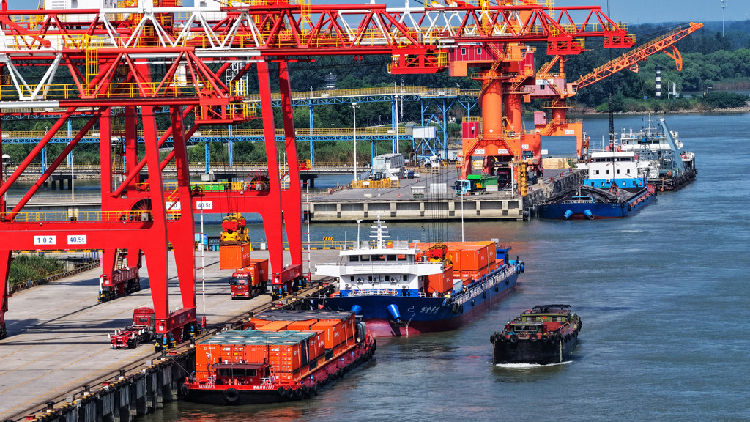
China's economy remained broadly stable in August, with growth increasingly supported by high-tech manufacturing, services and foreign trade, according to data released by the National Bureau of Statistics on Tuesday.
ANZ Group chief executive officer Nuno Matos has warned about the rising, unpredictable risks linked to artificial intelligence and failed to rule...
Nuno Matos adds that capital is not attracted to high-tax environments
US President Donald Trump dismisses calls to slow the development of AI, saying that claims of it "taking over the World" are a "HOAX".
The group could still buy small companies with services that would be “add-ons” to current businesses, he said
Relocation schemes offer support for people who want to swap big cities for a cheaper, quieter life.