BursaKL

Malaysian business and markets news

International

Business and economy news from other publishers, in Malaysia, the region and the world.

  1. HK exports surge to nearly all major markets

    Hong Kong recorded year-on-year increases in both exports and imports last month, with the outflow to almost all major markets seeing a sharp surge, the government said. Figures released by the Census and Statistics Department on Thursday showed that the value of total exports of goods increased by 53 percent over a year earlier to HK$667.9 billion in August. This came after a year-on-year increase of 50.7 percent in July. The value of imports also increased by 60 percent over a year earlier to HK$739.1 billion, compared with a year-on-year rise of 41 percent in July. In the first eight months of the year, Hong Kong saw a 42.5 percent rise in the value of total exports compared with the same period in 2025 while imports were up by 43.2 percent. A trade deficit of HK$371.2 billion, equivalent to 7.2 percent of the imports value, was recorded during the period. A government spokesman said Hong Kong’s merchandise exports continued to surge amid robust demand for AI-related electronic products. “Exports to almost all major markets increased markedly,” he said. “Looking ahead, sustained global demand for AI-related electronic products is expected to continue to support Hong Kong's merchandise trade performance in the near term. “Nonetheless, given the geopolitical tensions in the Middle East and continued protectionist trade measures among major advanced economies, the external environment remains uncertain and warrants close monitoring.” Edited by Tony Sabine

  2. China, US reach trade consensus and hold first AI dialogue

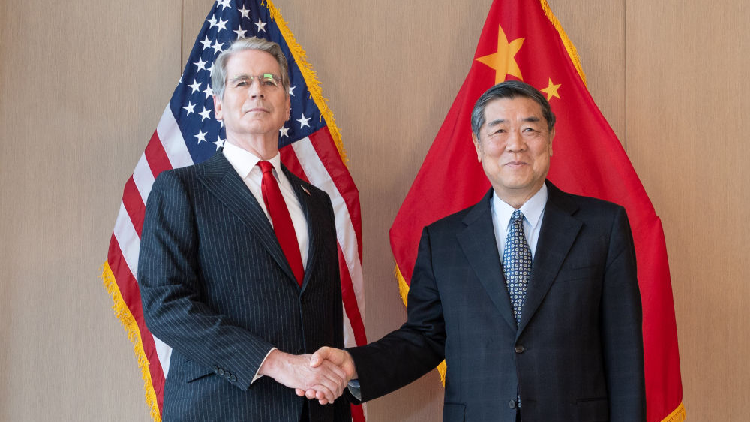
    China and the United States have reached consensus on multiple fronts during their eighth round of economic and trade consultations, the Ministry of Commerce said on Thursday. Under the consultation mechanism, Vice Premier He Lifeng and Treasury Secretary Scott Bessent held their first dialogue on artificial intelligence.

  3. HK slips as summit pessimism dogs mainland stocks

    Mainland stocks logged their worst day in a month on Thursday as investors remained sceptical that a meeting between President Xi Jinping and his US counterpart, Donald Trump, in Washington would produce a broader breakthrough. In Hong Kong, the benchmark Hang Seng Index lost 72 points, or 0.29 percent, to end at 24,761. The tech index was almost 18 points, or 0.41 percent, down at 4,361 while the China enterprises index was seven points, or 0.09 percent, lower at 8,266. Energy, banking and shipping stocks listed in Hong Kong outperformed, offsetting some of the losses in the SAR market. On the mainland, the blue-chip CSI300 Index fell 1.7 percent while the benchmark Shanghai Composite Index closed down 48 points, or 1.22 percent, at 3,888, with both indices marking their biggest one-day drop in a month. The Shenzhen Component Index fell 319 points, or 2.34 percent, to 13,316 while the ChiNext Index plunged 90 points, or 2.68 percent, to 3,288. Trump welcomed Xi to Washington on Wednesday for a three-day visit that will test relations between the two superpowers. Xi's first trip to the United States in nearly three years was not expected to yield major breakthroughs, but US Treasury Secretary Scott Bessent said the two countries agreed to extend a trade truce by two months. The extension is "shorter than market expectations" for a one-year rollover, but nonetheless helps preserve stability in the bilateral relationship, analysts at UBS said in a sales note. Also weighing on sentiment was the absence of a delegation of Chinese business leaders during Xi's visit, which Beijing had sought to bring for meetings with Trump, sources said. Most sectors were lower by midday, led by gold equities, non-ferrous metal and AI hardware stocks. The broad selloff also mirrored overnight weakness on Wall Street, where stocks retreated as higher oil prices and rising US Treasury yields dampened sentiment. Sanjeev Rana, head of north Asia semiconductors research at CLSA, said that while there are expectations around Beijing and Washington working together on AI development and making AI safe, he does not foresee any relaxation on chip-export controls from the US side. Some investors are more positive. "Trump is a very pragmatic president, and he understands comparative strength in the global economy very well," said Charles Wang, chairman of Shenzhen Dragon Pacific Capital Management. "I think US-China relations are evolving from outright confrontation, towards mutual understanding, compromise and a framework of co-existence." In Tokyo, the Nikkei rose 495 points, or 0.76 percent, to 65,513 in a holiday-shortened week as CPU-related stocks jumped after Meta unveiled its AI gadget Meta Charm, fuelling demand prospects for computer components. The broader Topix gave up early gains to slip 15 points, or 0.39 percent to 4,075. (Reuters/Xinhua) Edited by Tony Sabine